
Few animals carry as much symbolic weight as the owl, and remarkably little of that reputation is exaggeration. The biology behind how owls hunt is genuinely as remarkable as the folklore that grew up around them, and the two are more connected than most people realize.
How Owls Fly in Total Silence
Most birds’ wings make a distinct whooshing sound as air rushes over stiff feather edges. Owls have evolved a completely different wing structure specifically to avoid this. The leading edge of an owl’s flight feather has a soft, comb-like fringe that breaks up turbulent air into smaller, quieter currents. A velvety texture across the rest of the wing surface further absorbs sound, and a soft, fringed trailing edge lets air pass through gradually rather than snapping off the wing in a single audible burst. The combined effect is close to true silent flight, engineered entirely for the purpose of surprising prey that relies on hearing to detect danger.
Extraordinary Night Vision, With a Catch
Owl eyes are enormous relative to their skulls, packed with far more rod cells than human eyes, which makes them exceptionally good at gathering light in near-total darkness. The trade-off is flexibility: an owl’s eyes are fixed in their sockets and cannot rotate the way human eyes can. To compensate, owls can rotate their heads roughly 270 degrees, using specially adapted neck vertebrae and blood vessels that keep blood flowing even at extreme rotation angles, something that would cut off circulation in almost any other animal.
Hearing That Builds a Map in the Dark
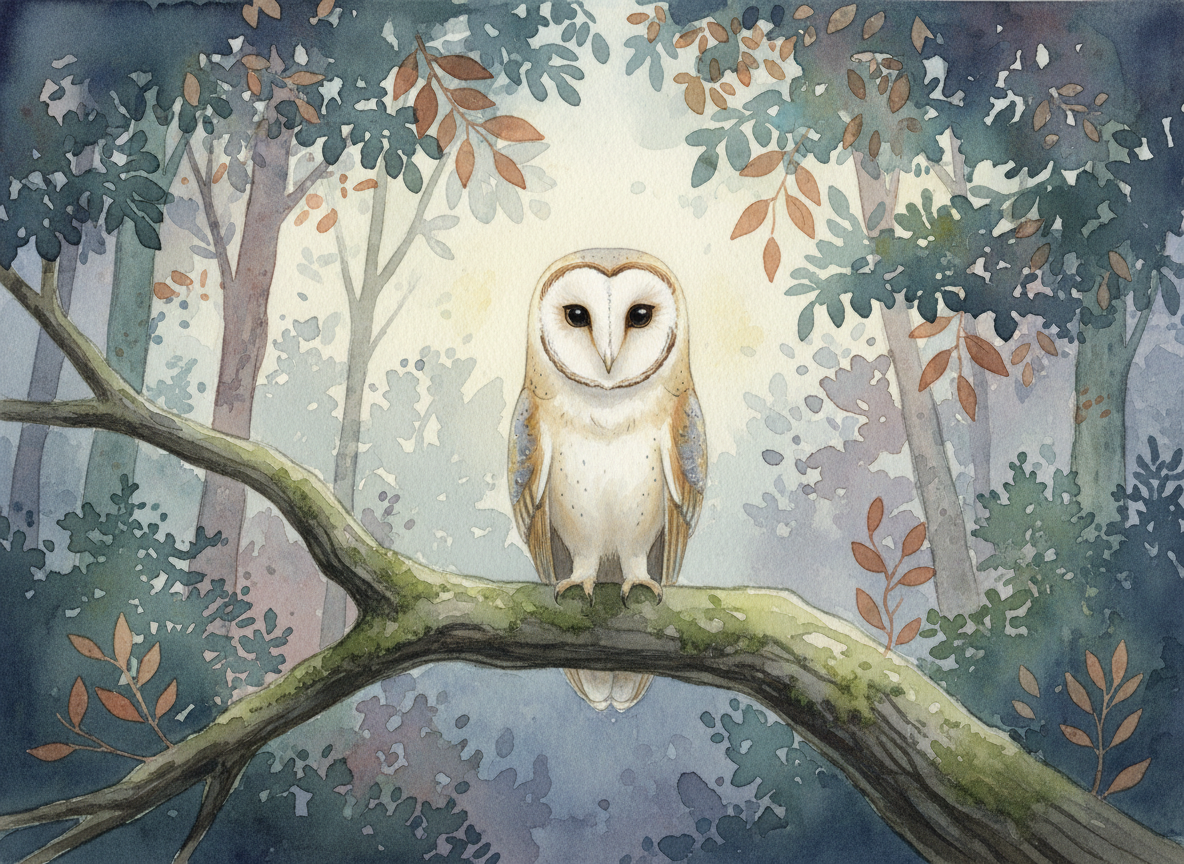
Many owl species, particularly barn owls, have ears positioned asymmetrically on their heads — one slightly higher than the other. This tiny offset lets an owl calculate the precise vertical and horizontal position of a sound source based on minuscule differences in when it reaches each ear. Combined with a facial disc of feathers that funnels sound toward the ears like a satellite dish, this gives owls the ability to hunt small prey moving under snow or thick grass using hearing alone, with no need to see the target at all.

Wisdom in Some Cultures, Warning in Others
Ancient Greece associated the owl with Athena, goddess of wisdom, and by extension with knowledge, strategy, and clear sight, both literal and intellectual — a reputation still reflected in the modern phrase “wise old owl.” But this positive association is far from universal. In many Indigenous cultures across the Americas, parts of Africa, and the Middle East, an owl’s call at night was traditionally interpreted as an omen of death or misfortune, likely tied to their nocturnal habits, unsettling silent flight, and eerie calls emerging from the dark. The same traits that made Greeks associate owls with keen insight made other cultures associate them with something to fear.
What both interpretations share is an acknowledgment that owls perceive things humans can’t: they see in darkness we can’t navigate, hear sounds we can’t detect, and move in a silence we can’t replicate. Whether that made a culture see them as wise guides or unsettling omens often came down to how comfortable that culture was with the unknown parts of the night.
Owls are one of our favorite subjects to illustrate too, available as watercolor wall art prints in our Etsy shop, NaturalEMNB.
 Cottagecore Prints
Leave a comment