
There’s a specific smell that shows up right before or during a rain shower — earthy, slightly sweet, unmistakably fresh — and almost everyone recognizes it instantly, even if they’ve never learned its name. That smell is called petrichor, and the science behind it turns out to be a small, quiet collaboration between bacteria, plants, and the mechanics of a falling raindrop.
Naming the Smell
The term “petrichor” was coined in 1964 by two Australian researchers, Isabel Joy Bear and Richard Thomas, who were studying the smell scientifically for the first time. They built it from Greek roots: “petra,” meaning stone, and “ichor,” the fluid said to run through the veins of the gods in Greek mythology. The name suggests something almost mythical seeping out of the earth itself, which, in a way, isn’t far from what’s actually happening.
The Three Ingredients Behind the Smell
Petrichor isn’t a single chemical. It’s a combination of a few different sources working together:
- Geosmin — an organic compound produced by soil-dwelling bacteria called actinomycetes. Geosmin is extraordinarily potent; the human nose can detect it at concentrations as low as 5 parts per trillion, making it one of the most sensitive smells we can perceive.
- Plant oils — during dry periods, plants release oils that settle into soil and rock surfaces. These oils build up over time and are released back into the air when rain disturbs the ground.
- Ozone — particularly noticeable before a storm, when electrical activity in the atmosphere splits oxygen molecules, some of which recombine into ozone and drift down on the breeze ahead of the rain itself.
How Rain Actually Releases the Smell
High-speed camera research has shown that when a raindrop hits a porous surface like soil, it traps tiny air bubbles at the point of impact. Those bubbles rise rapidly through the drop and burst at the surface, launching a fine mist of aerosols — essentially micro-droplets carrying geosmin, plant oils, and other compounds — up into the air where they can drift into your nose. Light or moderate rain actually produces more of this aerosol effect than a heavy downpour, which is part of why a gentle spring shower often smells more distinct than a violent storm.

Why We’re So Drawn to It
There’s a compelling evolutionary theory for why humans find this smell so pleasant: our ancestors likely relied on the ability to detect rain and moisture in the environment as a matter of survival, whether for finding water sources or anticipating a change in weather that affected food and safety. Some researchers suggest our noses may be unusually sensitive to geosmin precisely because being able to smell water, even indirectly, was once a genuine advantage. Whatever the exact reason, the association most people have with petrichor now is comfort: a cool breeze, a change in light, the sense that a garden or forest is about to be renewed rather than depleted.
A Smell With No Bottle
Perfumers have tried for decades to bottle petrichor convincingly, and while some come close, most people can tell the difference between a synthetic version and the real thing. Part of that may be because the smell isn’t really separable from the moment it arrives in: the temperature drop, the sound of the first drops on leaves, the particular quality of light under a clouding sky. Petrichor might be one of the few scents that’s genuinely inseparable from its setting — which is probably exactly why it feels so at home in a quiet, green, slightly overgrown garden after a storm.
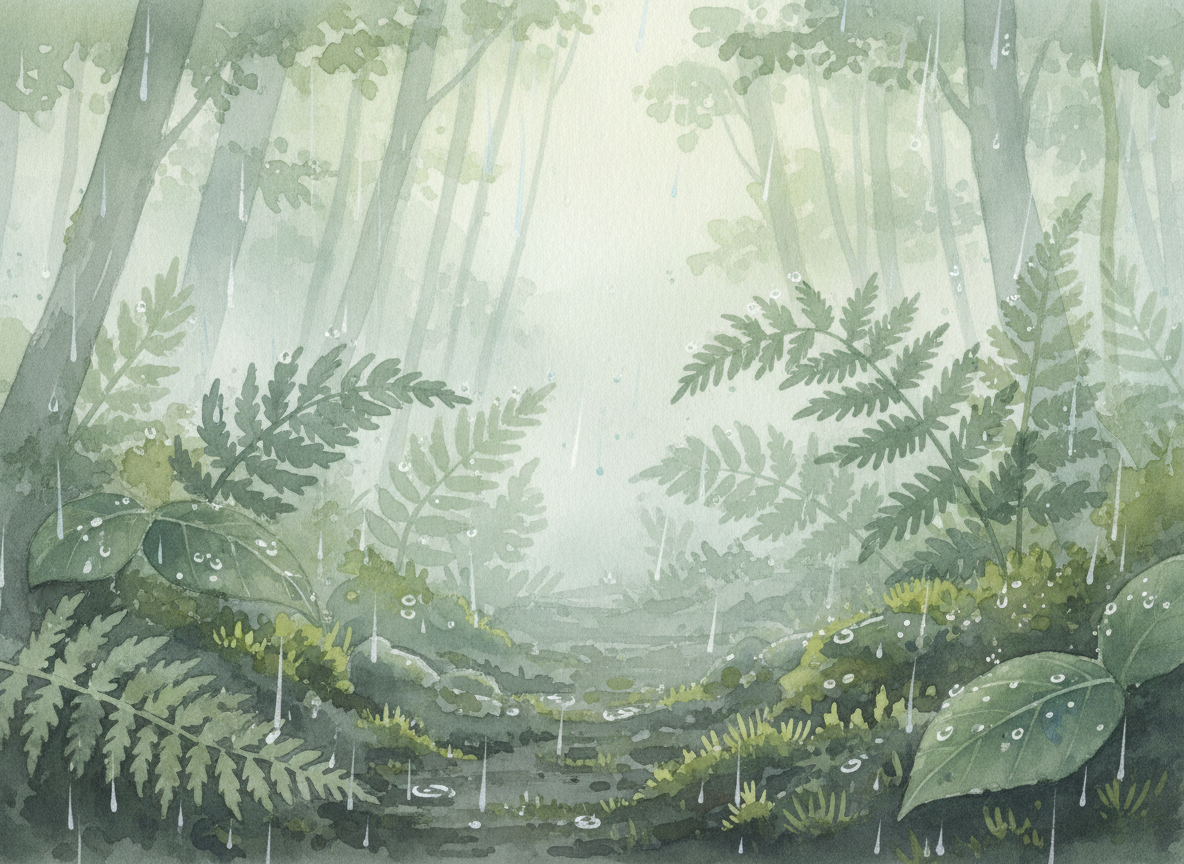
If you love that cozy, just-after-the-rain feeling as much as we do, we capture it in our woodland and garden watercolor prints, available in our Etsy shop, NaturalEMNB.
 Cottagecore Prints
Leave a comment